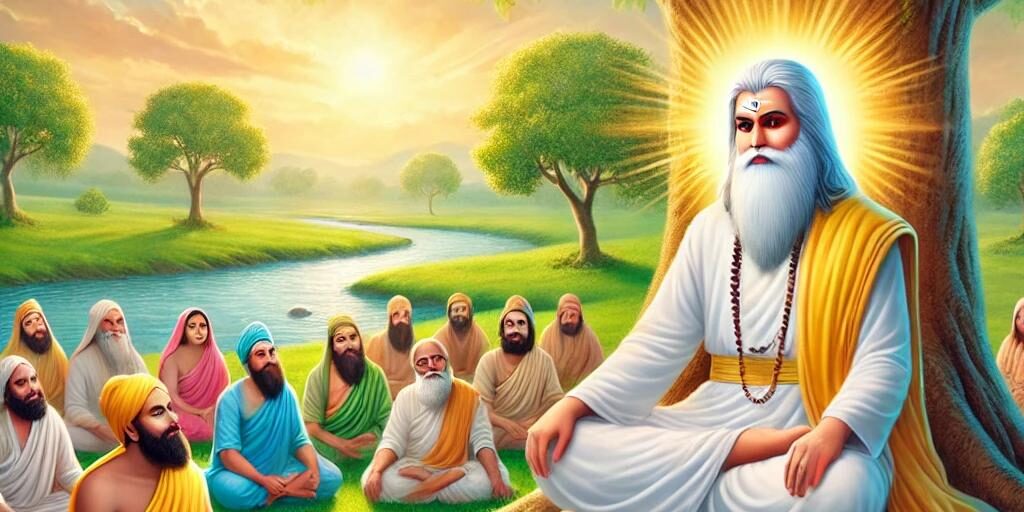
Guru Ravidas, the revered 15th-century saint, emphasized universal love, devotion, and liberation of the soul from worldly attachments. When interpreting what umeed (hope) could mean in the teachings of Guru Ravidas, we can frame it as the spiritual optimism that arises from faith in the Divine and the pursuit of righteousness. For Guru Ravidas, hope was not a worldly expectation but a deep trust in divine grace and the ultimate unity with God. Here’s how this concept can be explained using his teachings and examples:
- Umeed as Trust in Divine Grace
Guru Ravidas often spoke about surrendering to God’s will and finding hope in His infinite mercy. He said:
“Prabhuji, tum chandan hum paani, jake ang ang baas samaani.”(O Lord, You are sandalwood, and I am water; Your fragrance permeates my every atom.)
This reflects the hope (umeed) that divine grace transforms and uplifts us, even if we feel insignificant or impure. Just as water carries the fragrance of sandalwood, humanity can carry divinity with God’s mercy.
Example: A devotee might face struggles in life, but they keep hope in God’s plan, knowing that hardships are temporary and serve a greater purpose in spiritual growth.
- Umeed as the Hope for Liberation
For Guru Ravidas, the ultimate umeed was liberation from the cycle of birth and death (moksha) and attaining union with God. He expressed this beautifully:
“Begampura shehar ka nao, dukh andohu nahin thao.”(Begampura is the name of the city, where there is no suffering or sorrow.)
Here, Begampura symbolizes a realm free of pain, and Guru Ravidas offers hope to all that through devotion and righteous living, one can attain this spiritual state.
Example: A Ravidassia farmer might work hard under oppressive conditions but finds solace and hope in the belief that their spiritual efforts will lead them to Begampura, a place of eternal joy.
- Umeed as Faith in Equality
Guru Ravidas championed the idea of equality and social justice, inspiring hope for a world free of discrimination. He said:
“Man changa to kathoti mein Ganga.”(If your heart is pure, the holy Ganges can be found even in a small bowl.)
This conveys the hope that God does not discriminate by caste, status, or wealth. He values inner purity and devotion over external rituals.
Example: A marginalized person finds hope in Guru Ravidas’s message, believing that their devotion is just as valuable as that of a wealthy priest, regardless of societal hierarchies.
- Umeed as Inner Strength During Adversity
Guru Ravidas taught resilience and patience through trust in divine timing. He believed that even during hardship, one must not lose hope, as God’s grace is ever-present:
“Jo har rang laago mera chit, so kahan kare kai dusht jhit.”(When my mind is absorbed in God’s love, no evil can harm me.)
This reinforces the idea that hope (umeed) is the strength that keeps one steadfast in devotion and moral integrity, even when facing injustice.
Example: A devotee suffering from poverty or discrimination may draw hope from Guru Ravidas’s teachings, finding peace in their spiritual connection to God.
Conclusion
When Guru Ravidas was asked, “What is umeed?” he might have answered through his teachings that hope is:
•   Faith in the Divine’s mercy and justice.
•   A belief in liberation and spiritual joy.
•   Optimism for a world free from inequality.
•   Strength to endure hardships with devotion.
Guru Ravidas’s umeed was never rooted in material desires but in the eternal and universal truths of God’s love and the transformative power of devotion.